


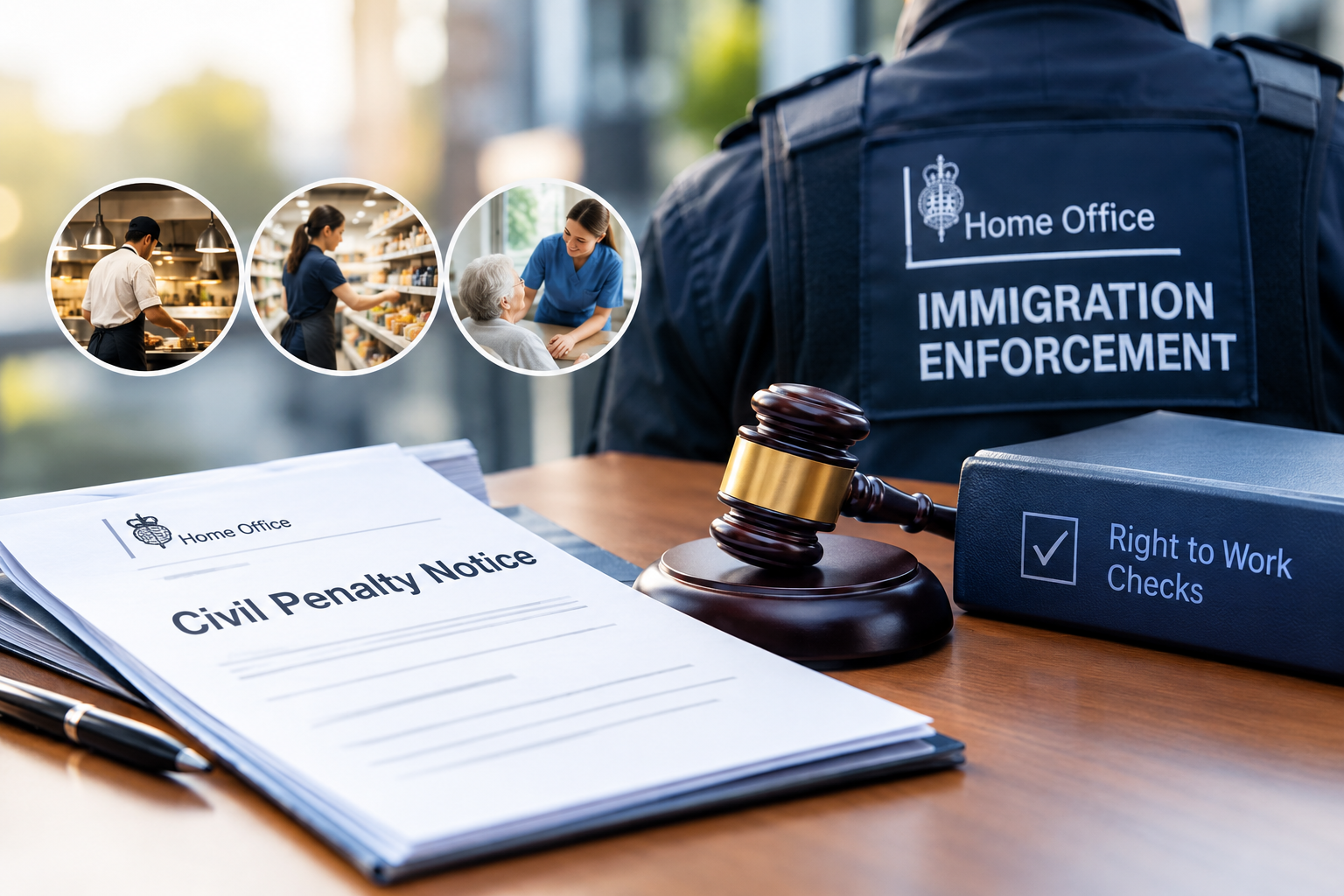
The Home Office has significantly increased enforcement activity against employers suspected of hiring workers without lawful immigration status. Many businesses across the restaurant, retail and care home sectors are now facing unexpected compliance visits and substantial civil penalties.
In recent months I have advised a number of employers who received sudden Notices of Liability ranging from £35,000 to £120,000. In several cases, decisive early intervention resulted in the penalties being cancelled entirely, preventing businesses from being pushed into insolvency.
This article explains how the civil penalty regime operates, why certain sectors are targeted more heavily, and what employers should do immediately if they receive a Warning Notice or Civil Penalty Notice.
Why Are Certain Sectors Targeted More Heavily?
Although any employer can be investigated, Immigration Enforcement focuses on industries where illegal working is statistically more common. Restaurants, retail outlets and care homes are inspected far more frequently than other sectors. These businesses often rely on large workforces, shift patterns, agency staff or high turnover, which increases the risk of administrative oversight or incomplete right to work checks.
In many matters I have handled, employers believed their procedures were adequate yet were still issued with penalties. The Home Office’s approach is strict, and even minor errors can lead to significant consequences.
What Happens During an Immigration Enforcement Visit?
A visit from Immigration Enforcement may be unannounced. Officers may interview staff, inspect documents and request evidence of right to work checks. Employers are often placed under pressure to produce records immediately, even if the relevant documents are held off site or by a third-party administrator.
Following the visit, officers prepare a report which forms the basis of any enforcement action. If they believe that one or more workers did not have the right to work, the employer will receive either a Warning Notice or a Civil Penalty Notice.
What Is a Warning Notice?
A Warning Notice is issued where the Home Office accepts that a breach occurred but decides not to impose a financial penalty. This is usually because the employer has some evidence of compliance or because it is a first offence. A warning remains on record and will be taken into account in any future investigation.
What Is a Civil Penalty Notice?
A Civil Penalty Notice is far more serious. Penalties can be up to £60,000 per worker depending on the circumstances and the employer’s compliance history. The notice will set out the alleged breach, the amount of the penalty and the deadline for payment or objection. Employers have a limited period in which to challenge the decision.
Understanding the Statutory Excuse.
Central to the civil penalty regime is the concept of the statutory excuse. This is the legal protection that shields employers from penalties if correct right to work checks were carried out. The statutory excuse may be lost if checks were incomplete, documents were not copied correctly, follow-up checks were missed or the wrong type of check was performed.
In many cases, the statutory excuse can be restored or evidenced through demonstrating partial compliance, showing that the Home Office misunderstood the worker’s status or proving that checks were carried out but not properly recorded.
The Home Office does make errors. In several matters I have handled, penalties were reduced or cancelled because the Home Office misidentified a worker’s immigration status, failed to consider partial checks, misunderstood sponsorship conditions or incorrectly calculated penalty levels.
Civil penalties can be reduced or cancelled entirely if the right representations are made. The Home Office must consider whether correct checks were carried out, whether the breach was deliberate, the employer’s compliance history and whether the assessment contains factual or procedural errors.
In recent matters, penalties of £35,000, £60,000 and £120,000 were avoided once the Home Office was presented with a detailed explanation of the employer’s procedures, evidence of partial compliance or proof that the alleged breach was based on incorrect assumptions. Prompt, well-structured representations make a decisive difference.
Employers should not ignore a Warning Notice or Civil Penalty Notice. Deadlines are strict. Employers should gather right to work documentation, identify any agency involvement, prepare a timeline of events and seek legal advice immediately. Early intervention is often the difference between a cancelled penalty and a financially damaging outcome.
As a senior consultant solicitor with over 25 years’ experience, I advise employers across the restaurant, retail, care home, construction and wider commercial sectors. My assistance includes reviewing the Notice of Liability, assessing the strength of the Home Office’s case, preparing detailed written representations, challenging incorrect assumptions and guiding employers through the objection and appeal process.
Every instruction to me is handled personally, with clear, decisive guidance tailored to the needs of the business. If you have received a Warning Notice or Civil Penalty Notice, or if you are concerned about your right to work procedures, you can contact me directly for confidential advice.
CONTACT DETAILS
Kuldeep S. Clair
Senior Consultant Solicitor – Phone: 07484 614090