


By Kuldeep S. Clair, Senior Solicitor, 25+ years of experience.
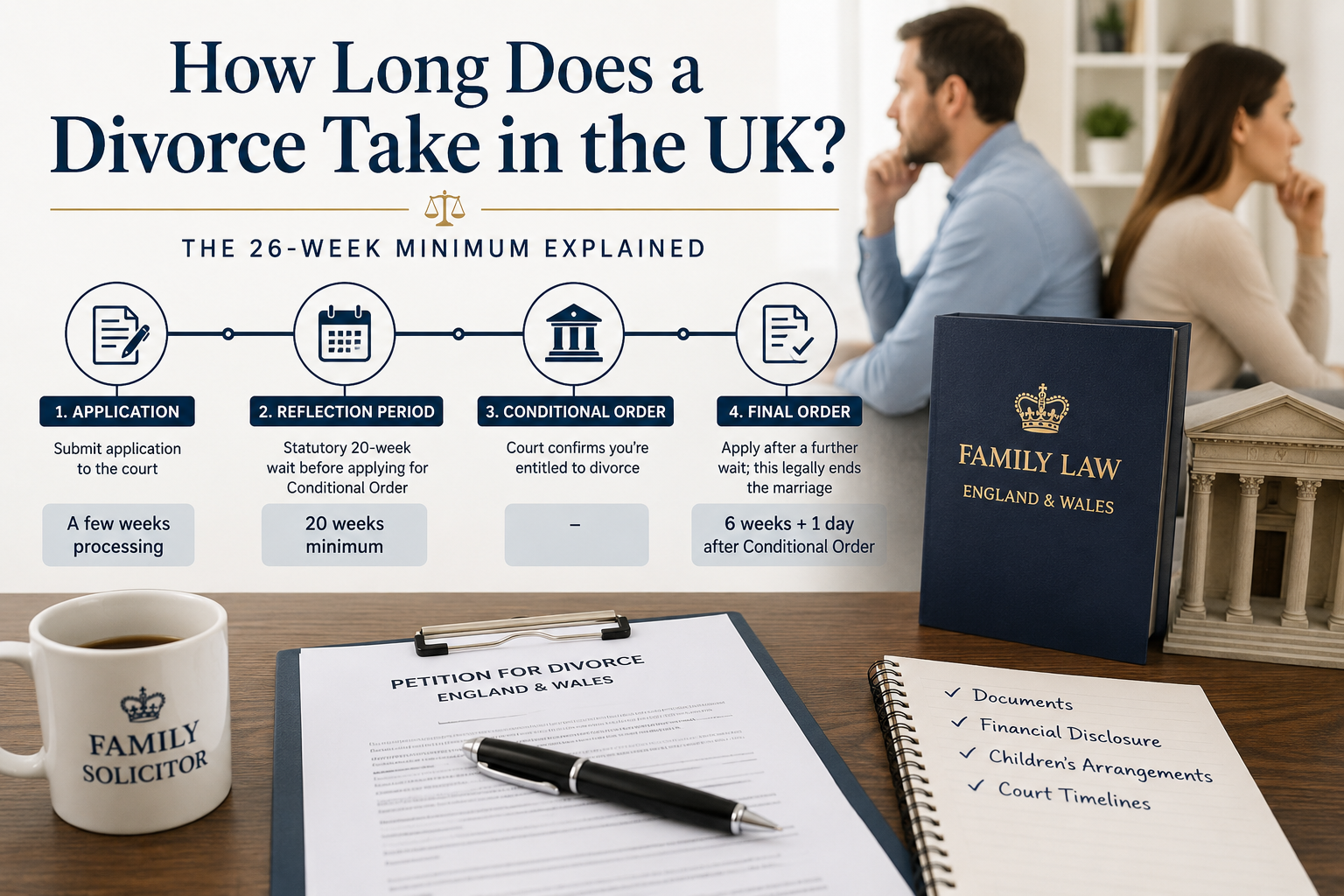
By law, a divorce in England and Wales cannot be finalised in under 26 weeks.
In practice, most people are looking at somewhere between seven and twelve months.
That gap between the legal minimum and the real-world average is where most of my clients get frustrated.
Nobody tells them the difference upfront, so they assume something has gone wrong when their case runs past six months.
It usually hasn’t. It’s just how the process works.
Below is the honest version the stages, the realistic timeframes, and what actually causes delay in my experience.
The Legal Process, Step by Step
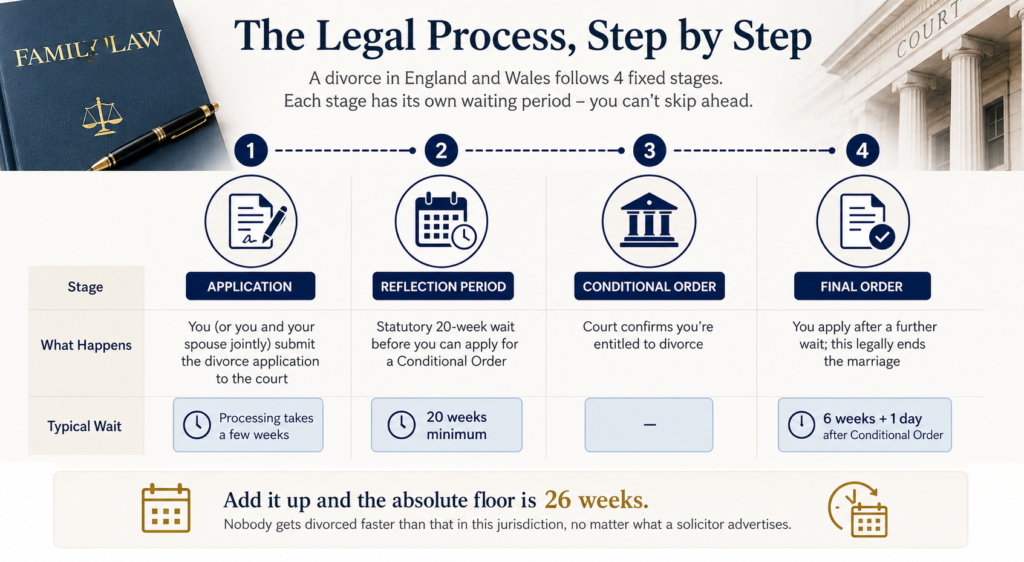
A divorce moves through four fixed stages once you apply.
Each one has its own waiting period, and you can’t skip ahead regardless of how straightforward your case is.
| Stage | What Happens | Typical Wait |
| Application | You (or you and your spouse jointly) submit the divorce application to the court | Processing takes a few weeks |
| Reflection period | Statutory 20-week wait before you can apply for a Conditional Order | 20 weeks minimum |
| Conditional Order | Court confirms you’re entitled to divorce | — |
| Final Order | You apply after a further wait; this legally ends the marriage | 6 weeks + 1 day after Conditional Order |
Add it up and the absolute floor is 26 weeks.
Nobody gets divorced faster than that in this jurisdiction, no matter what a solicitor advertises.
Joint vs Sole Applications
It matters whether you apply together or on your own, but not for speed.
The 26-week clock runs the same either way.
If you apply jointly, you both simply wait out the reflection period together.
If you apply alone, your spouse has 14 days to respond once the court sends them the application.
They can agree, or they can raise a genuine legal objection — they cannot dispute a divorce purely because they don’t want one or are trying to stall it.
If they don’t respond at all, you’re not stuck.
The court will tell you what to do next, and the case can still proceed.
Uncontested vs Contested: Realistic Timelines
This is the honest answer to “how long will mine take,” and it depends almost entirely on one thing: whether you and your spouse agree.
Uncontested, no financial dispute: roughly 6 to 7 months. This assumes clean paperwork, a joint or unopposed application, and no argument over money or children.
Contested, or with unresolved finances or children arrangements: 12 to 18 months is common. Some cases run longer.
The divorce itself, the legal end of the marriage, is often the easy part.
It’s the financial remedy proceedings that usually take longer, and I’d strongly advise against rushing to finalise the divorce before that’s sorted.
What Actually Causes Delay
In my experience, it’s rarely the court that’s the bottleneck. It’s usually one of these:
- Incomplete or incorrect paperwork on the initial application
- Unresolved financial disclosure property, pensions, and savings not properly declared
- Disputes over children’s arrangements
- Court backlogs, which vary by region and are genuinely outside anyone’s control
- A spouse who simply doesn’t engage with the process
There’s a risk here that people don’t think about until it’s too late.
If you finalise your divorce (get the Final Order) before your financial settlement is legally recorded in a court order, you can lose protections you didn’t know you had.
Spousal pension rights can disappear if your ex-spouse dies before the settlement is sealed.
Remarrying before a settlement is reached can block you from claiming one at all.
I always tell clients: get divorced when you’re ready, but don’t apply for the Final Order until the money is sorted and locked into a court order.
How to Avoid Unnecessary Delay
Some of this is within your control. A few things that consistently save my clients months:
- Get your documents together early marriage certificate, financial statements, property details
- Apply jointly where the relationship allows it
- Start financial disclosure straight away, not after the Conditional Order
- Respond to court correspondence promptly, don’t let deadlines slip
None of this guarantees a fast divorce. It just removes the delays that are entirely avoidable.
If you and your spouse are still working things out before applying, a separation agreement can settle the practical points in advance and save time later.
Does a “Quickie Divorce” Actually Exist?
You’ll see the phrase in the press whenever a celebrity split makes headlines.
It suggests some divorces move faster than others through a loophole.
They don’t. Not anymore.
The term dates back to the old fault-based system, before 2022, when citing blame could shortcut a two-year separation wait.
Under the current no-fault system, every divorce, famous or not, is subject to the same 26-week minimum.
Frequently Asked Questions
How long does an uncontested divorce take in the UK?
Around 6 to 7 months from application to Final Order, assuming both parties agree and paperwork is correct.
Does having children delay a divorce?
Not the divorce itself, but unresolved arrangements for children often run alongside it and can extend the overall timeline significantly.
What happens if my spouse won’t respond to the application?
The court will contact you with next steps. It’s not an automatic block, but it does add time.
Should I finalise my divorce before agreeing finances?
I’d advise against it. Get the financial settlement sealed in a court order first — otherwise you risk losing pension rights or the ability to claim a settlement at all.
Can I speed up my divorce?
You can’t beat the 26-week legal minimum, but clean paperwork, joint applications, and early financial disclosure avoid the delays that push cases past a year.
Why Work With a Solicitor Directly
Every case above is a general timeline. Yours won’t be identical to any of them.
That’s the conversation worth having before you apply, not after something’s gone wrong.
When you instruct me, you deal with me directly not a call centre, not a rotating team of juniors.
I’ve been doing this for 25 years, and I’ll tell you honestly where your case sits and what to expect, not just what you want to hear.
Not sure what to look for in a solicitor in the first place? Here’s how to go about choosing the right solicitor for your situation.
If you’re weighing up next steps, get in touch with one of the family law solicitors in London clients trust, or read more on family law and divorce.
Book a Consultation call 07484 614 090 or use the contact form to speak to Kuldeep directly.