


Kuldeep S. Clair, Senior Solicitor, 25+ years experience
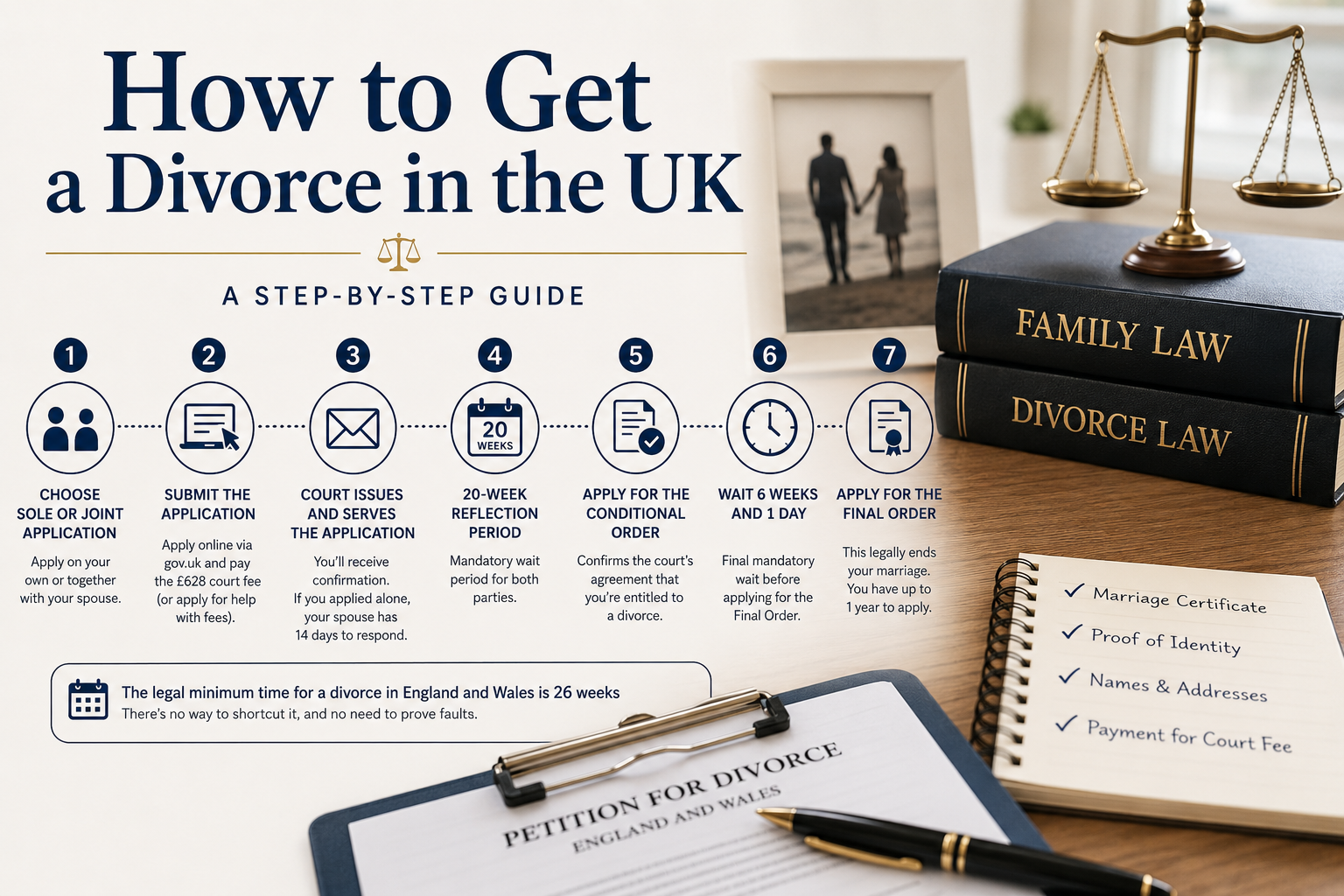
Getting a divorce in England and Wales means working through a fixed legal process: apply, wait 20 weeks, apply again, wait 6 weeks, then finalise.
There’s no way to shortcut it, and no need to prove fault against your spouse to start.
Below is exactly how it works, step by step, in plain English.
Get a Divorce in 7 Steps
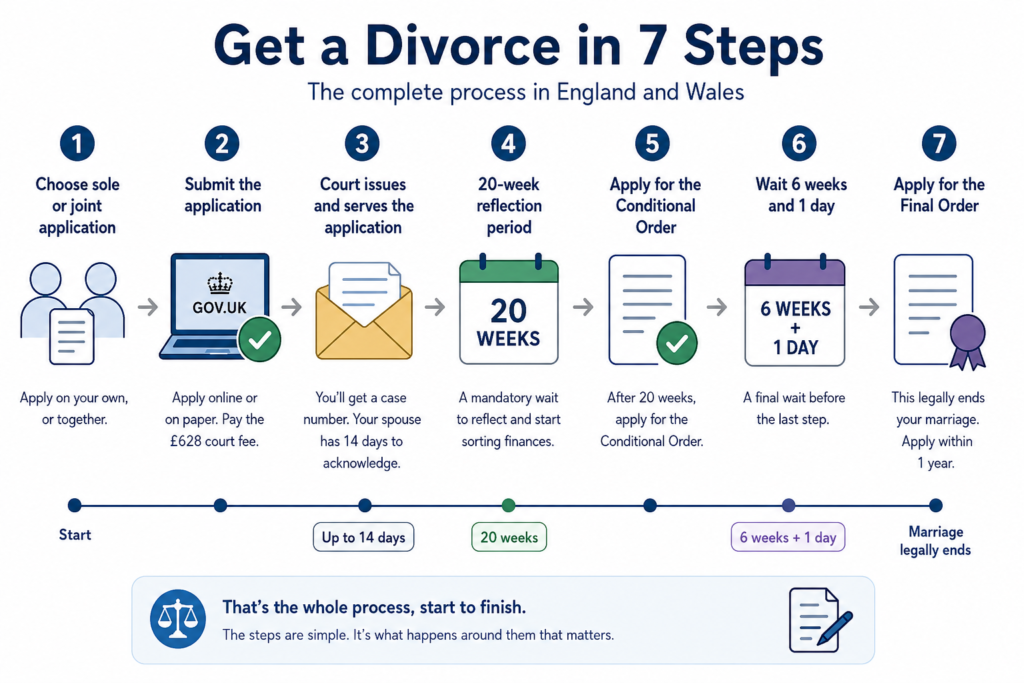
1. Choose sole or joint application:
You can apply on your own, or together with your spouse as a joint application. Joint applications tend to run more smoothly, but a sole application is often necessary if your spouse isn’t willing to cooperate.
2. Submit the application:
Most people apply online through the gov.uk portal, though a paper application is still accepted. You’ll need to pay the current £628 court fee at this stage, or apply separately for help with fees if you’re eligible.
3. Court issues and serves the application:
Once the court processes your application, you’ll receive confirmation and a case number. If you applied alone, your spouse is sent a copy and must acknowledge it within 14 days.
4. 20-week reflection period:
This is the mandatory statutory wait built into every divorce, regardless of how straightforward the case is. It’s meant to give both parties time to reflect, and it’s also a sensible window to start sorting out finances.
5. Apply for the Conditional Order:
Once the 20 weeks have passed, you apply for the Conditional Order, confirming the court’s agreement that you’re entitled to divorce. This isn’t the end of the marriage yet it’s the formal step just before it.
6. Wait 6 weeks and 1 day:
After the Conditional Order, there’s a final mandatory wait before you can take the last step. This period exists to allow time for financial or practical matters to be finalised before the marriage legally ends.
7. Apply for the Final Order:
This is the document that legally ends your marriage, and you must apply for it it isn’t issued automatically. You have up to a year from the Conditional Order to do this before further court steps become necessary.
That’s the whole process, start to finish.
The detail that trips people up isn’t the steps themselves. It’s what happens around them so let’s go through the parts that matter.
Are You Eligible?
Before you apply, you need to meet a few basic conditions.
- You’ve been married for at least one year
- Your marriage is legally recognised in the UK
- Your marriage has irretrievably broken down
- You or your spouse meet the residency requirement
You don’t need to prove why the marriage broke down. Since 2022, the UK has operated a no-fault system a simple statement that the marriage has broken down is enough.
Is Divorce Your Only Option?
Not always. Divorce is the right route if you want to legally end the marriage, but it isn’t the only one.
A separation agreement lets you live apart and sort out finances and arrangements without formally ending the marriage.
An annulment is different again it applies where the marriage wasn’t legally valid in the first place, rather than where it’s broken down.
Which route fits depends on your circumstances, and it’s worth a proper conversation before you commit to one.
What You’ll Need Before You Apply
Get these together before you start the application it avoids the most common cause of early delay.
- Your full name and address, and your spouse’s
- Your original marriage certificate, or a certified copy (with a certified translation if it’s not in English)
- Proof of any name change, if applicable
- A payment method for the court fee
Missing or incorrect documents at this stage is one of the most avoidable reasons an application gets held up.
Sole vs Joint: Which Is Faster?
Both routes run on the same statutory minimum, but joint applications tend to move through the system somewhat faster in practice.
That’s usually down to cooperation, not the process itself. When both parties respond promptly and there’s no dispute to manage, cases naturally progress with fewer hold-ups.
If you and your spouse are on reasonably good terms, a joint application is generally the smoother option.
Do You Need a Solicitor to Get a Divorce?
Legally, no. You can complete the application yourself, and many people do.
Where it gets risky is everything around the divorce not the divorce itself.
The most common mistake I see is someone finalising their divorce, then remarrying, before their financial claims are settled. Once you remarry, you can lose the right to bring certain financial remedy proceedings against your ex-spouse entirely.
That’s not a technicality. It can mean losing a share of a pension or a settlement you were otherwise entitled to.
What It Costs
The court fee to apply is currently £628.
If you’re on a low income or receiving certain benefits, you may be able to apply for help with this fee it’s a separate application, made alongside or before your divorce application.
Beyond the court fee, solicitor costs vary depending on how much support you need. I’ve written more on how much a solicitor is likely to cost if you want a realistic sense of the numbers before you commit to anything.
After the Final Order
Getting the Final Order ends the marriage legally, but it’s not quite the end of the admin.
You’ll usually need to update your will, notify your bank and pension providers, and update any records still in your married name.
If your financial settlement isn’t finalised yet, that should be your next priority not something left to sort out later.
Frequently Asked Questions
Can I get a divorce without a solicitor?
Yes, legally you can complete the process yourself. The risk isn’t the divorce application it’s the financial and practical decisions around it.
Does my spouse have to agree to the divorce?
No. Either party can apply, and the other cannot block it simply because they don’t want a divorce.
Can I apply if we got married abroad?
Yes, provided your marriage is legally recognised in the UK and you meet the residency requirement.
What if I can’t afford the court fee?
You may qualify for help with fees if you’re on a low income or receiving certain benefits this is a separate application made alongside your divorce application.
Why Work With a Solicitor Directly
Everything above covers the standard process. Your situation will still have its own detail finances, property, children, or simply what to prioritise first.
That’s worth a proper conversation, not a generic checklist.
When you instruct me, you work with me directly from the first call through to the Final Order not a call centre, not a junior handling your file.
If you’re not sure where to start, here’s how to go about choosing the right solicitor in the first place.
Get in touch with one of the family law solicitors in London
Book a Consultation call 07484 614 090 or use the contact form to speak to Kuldeep directly.