


If you’re reading this, chances are an invoice is sitting overdue right now, and you want to know two things: what the law actually lets you do about it, and how far you can push before you need to hand it to a solicitor. This isn’t a general explainer written for exam revision. It’s written for the moment you’re in.
We’ll go through the interest and compensation you’re entitled to, when a letter before action actually works, when court is the right call, and what’s changing in the law during 2026 that most guides haven’t caught up with yet.
Why an Unpaid Invoice Is a Legal Problem, Not Just a Cash Flow One
Most business owners treat a late invoice as an admin headache.
Send a reminder, wait a bit longer, chase again.
The trouble is, by the time it’s been three months, you’ve lost leverage.
Under non-payment of invoice law in the UK, you actually have clear statutory rights from day one. Most people just never use them until it’s almost too late.
What the Late Payment of Commercial Debts Act Actually Gives You
This is the piece of legislation that matters most, and it’s genuinely underused.
The Late Payment of Commercial Debts (Interest) Act 1998 applies to business-to-business transactions in the UK.
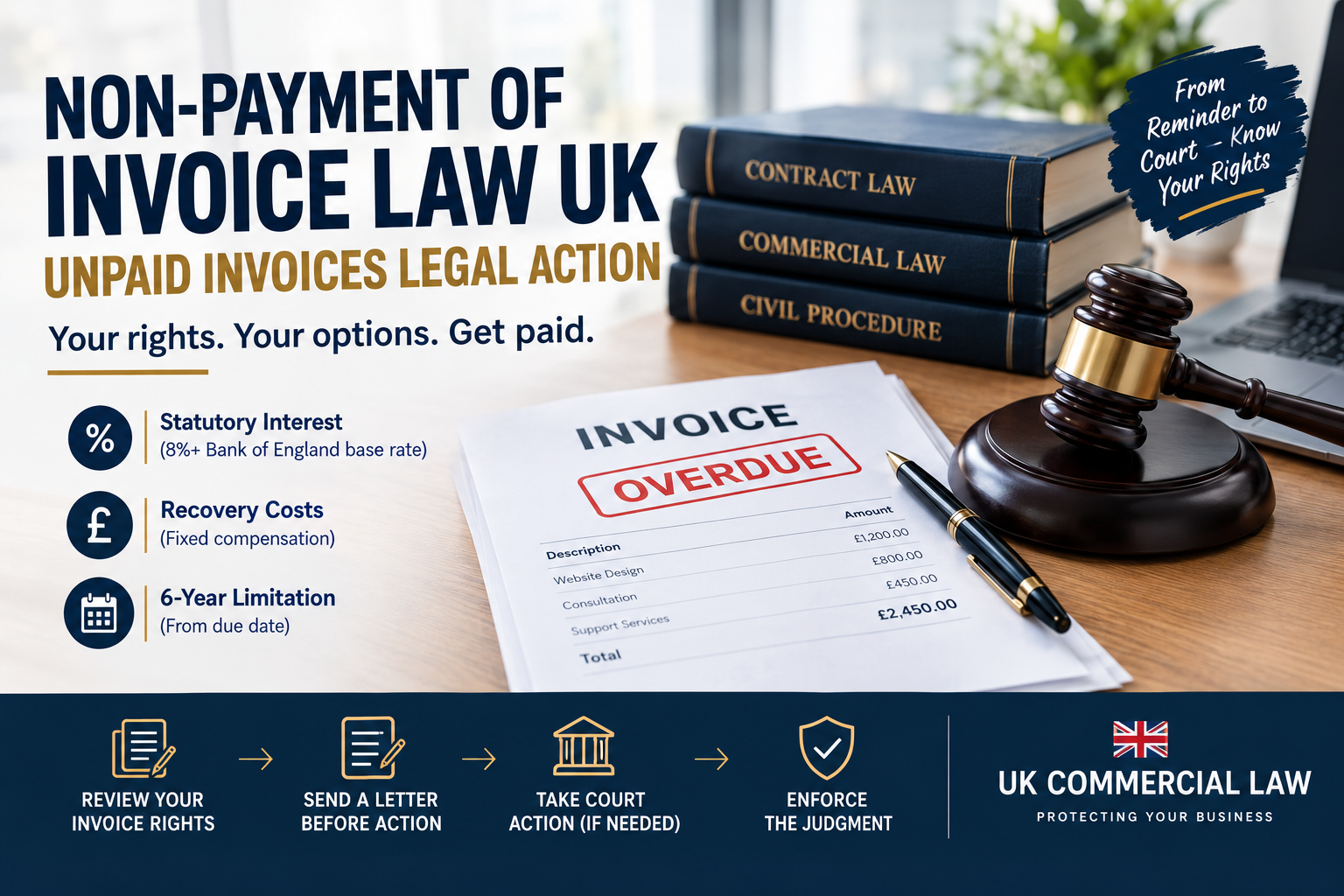
It gives you two separate rights: statutory interest, and a fixed sum to cover your own costs of chasing the debt.
How the interest is actually calculated
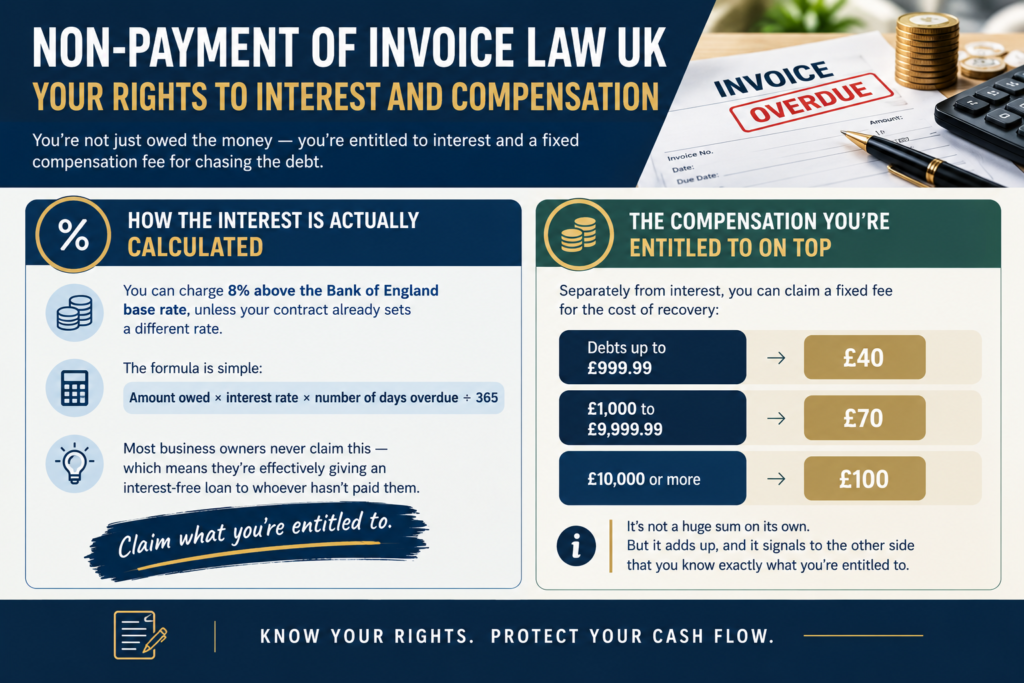
You can charge 8% above the Bank of England base rate, unless your contract already sets a different rate.
The formula is simple:
Amount owed × interest rate × number of days overdue ÷ 365
Most business owners never claim this which means they’re effectively giving an interest-free loan to whoever hasn’t paid them.
The compensation you’re entitled to on top
Separately from interest, you can claim a fixed fee for the cost of recovery:
- Debts up to £999.99 → £40
- £1,000 to £9,999.99 → £70
- £10,000 or more → £100
It’s not a huge sum on its own.
But it adds up, and it signals to the other side that you know exactly what you’re entitled to.
The Six-Year Rule Nobody Mentions Until It’s Nearly Run Out
Here’s a question I get asked more than almost any other: how long do I actually have to chase this?
For a standard commercial debt, you have six years from the date payment was due to bring a claim.
Two things trip people up here.
First, if the debtor writes to acknowledge the debt, or makes any partial payment, the clock resets and starts running again.
Second, six years feels like a long time until you realise most people wait far too long to act, and by then the company has often quietly dissolved.
When “They’re Just Slow” Is Actually a Dispute
Not every unpaid invoice is straightforward non-payment.
Sometimes what looks like someone dragging their feet is actually a genuine disagreement about the quality of work, whether it was delivered on time, or whether the scope even matches what was agreed.
This distinction matters enormously, because the legal route you take depends entirely on which one you’re dealing with.
If there’s a real dispute, court action can be the wrong first move mediation or a straight commercial conversation often gets there faster and cheaper.
If there’s no dispute at all and they’ve simply gone quiet, that’s when formal legal action for non-payment of invoices becomes the right tool.
We’ve written separately about the wider picture of debt and money claims if you want the fuller view of how these cases typically play out.
Sending a Letter Before Action Where Most People Go Wrong
A Letter Before Action, or LBA, is a formal warning that court proceedings will follow if payment isn’t made.
It’s not just a strongly worded email. Courts expect it to include specific information, and getting it wrong can actually cost you later.
A proper LBA should set out:
- The debtor’s full name, trading status, and address
- The exact amount owed and how it arose
- A copy of the invoice or agreement (even if it was a verbal one)
- Any interest or compensation already accruing
- A clear deadline usually 14 days for a business
- Confirmation that court proceedings will follow if unpaid
Send it by both email and recorded post.
I’ve had cases where a well-drafted LBA alone was enough the debtor paid within days rather than face the reality of court papers landing on the desk.
If you’ve received one of these letters yourself rather than sent one, it’s worth reading how to respond to a solicitor’s letter without making things worse before you reply to anything.
Unpaid Invoices Legal Action: What Happens If the LBA Is Ignored
If the debtor doesn’t respond, the next step is a court claim.
For most business debts, this means either Money Claim Online (MCOL) or a paper N1 form through the County Court.
If the debtor doesn’t file a defence or acknowledgment within the deadline, you can apply for judgment in default essentially, the court rules in your favour because the other side didn’t turn up to argue their case.
That’s often where people assume the story ends. It doesn’t.
Getting a judgment and actually being paid are two different things
A judgment confirms you’re owed the money.
It doesn’t put it in your bank account.
If the debtor still doesn’t pay, enforcement options include county court bailiffs, High Court Enforcement Officers, or a charging order against property they own.
I dealt with a case recently where a director ignored two letters before action, ignored the court papers entirely, and only responded once enforcement was actually threatened, at which point excuses about “the accountant not passing on the post” suddenly appeared. You can read how that one played out in this case study on recovering an outstanding commercial debt.
If you’re on the other side of this trying to have a default judgment set aside because you never actually saw the claim, that’s a different process, and a time-sensitive one. We’ve covered it separately in how to set aside a CCJ or high-value judgment.
Statutory Demands and Winding-Up Petitions Use These Carefully
When a debtor is a limited company, a statutory demand can sometimes move things faster than court.
It’s a formal demand giving the company 21 days to pay.
If they don’t respond, you can potentially apply to wind the company up a serious step, and one that can carry personal consequences for the directors involved.
That’s a real point worth understanding properly, and we’ve explained it in more depth in our article on the personal liability of directors.
This route only really makes sense where the debt is undisputed and reasonably clear-cut.
If there’s any genuine argument about whether the money is owed, a statutory demand can backfire and simply give the debtor grounds to have it set aside.
What’s Changing in 2026: Late Payment Legislation to Watch
This is the part most guides on this topic won’t have caught up with yet.
In March 2026, the Department for Business and Trade announced new measures aimed squarely at late payment culture.
Under the proposed changes, large companies will be required to pay smaller suppliers within 60 days.
Statutory interest at 8% above the Bank of England base rate is set to apply automatically across commercial contracts, rather than something you have to actively rely on.
A new time limit for raising disputes about an invoice has also been proposed likely around 30 days, though the final detail is still being confirmed.
If you’re a small business regularly dealing with slow-paying larger clients, this is worth watching closely over the coming months, because it directly affects your leverage.
Should You Chase This Yourself, or Bring in a Solicitor?
Honestly, not every unpaid invoice needs a solicitor.
If the debt is small, undisputed, and the debtor is simply disorganised, a firm written chaser and MCOL claim can do the job on your own.
Where it genuinely tips into needing proper legal help is when the debt is disputed, the debtor has gone completely silent, the sum involved is significant, or there’s a real risk they’re insolvent.
Cross-border debts add another layer of complexity most business owners aren’t equipped to navigate alone.
I’d rather tell a client honestly that their case isn’t worth the legal spend than take it on regardless you can read more about how we price this kind of work on our fees and costs page.
For a broader look at how this fits into commercial law generally, our commercial law for UK businesses guide is a useful starting point too.
Talk to Kuldeep Directly
If you’re dealing with an unpaid invoice and want a straight answer on where you stand, you won’t be passed between departments here.
You’ll speak to me directly, from the first call.
I’ve spent 25 years handling exactly these disputes sometimes as far as court, often resolved long before it gets there and I’ll tell you honestly whether it’s worth pursuing before you spend a penny on legal fees.
For the full range of contract and commercial work we handle, visit our commercial lawyer London page, or head back to KSC Legal to see how we work.
Call 07484 614 090, or send an initial enquiry there’s no charge for that first conversation.