


By Kuldeep S. Clair, Senior Solicitor & Advocate 25+ years’ experience
Something has gone wrong at work. Maybe you’re an employer trying to work out if you can dismiss someone on the spot. Maybe you’re an employee who’s just been accused or sacked and you’re wondering if it was even legal.
Either way, you’ve landed in the right place.
This guide gives you a straight answer to what are examples of gross misconduct, what the law actually says, and what to do next, whichever side of the desk you’re sitting on.
Gross misconduct is behaviour so serious it destroys the trust between an employer and an employee serious enough to justify dismissal without notice.
Gross misconduct does not always lead to dismissal automatically. The employer still has to investigate fairly, hold a proper hearing, and follow the ACAS Code of Practice or the dismissal itself can be challenged.
If you’re dealing with a real situation right now, keep reading. Or get in touch with KSC Legal directly and we’ll talk it through.
What Is Gross Misconduct?
Let’s start with the basics.
What does gross misconduct mean? In plain English, it’s conduct so serious that it breaks the employment relationship beyond repair.
It’s not a bad day. It’s not a mistake. It’s behaviour an employer simply cannot overlook.
Legally, gross misconduct is defined as conduct that fundamentally breaches the trust and confidence between employer and employee. That breach is what gives the employer the right to end the contract without notice known as summary dismissal.
Compare that to ordinary misconduct lateness, a missed deadline, a rule broken by accident. That’s usually handled with a warning, not a sacking.
What constitutes gross misconduct, then, comes down to one test:
Was the conduct serious enough that continuing to employ the person is no longer realistic?
If yes, you’re likely in gross misconduct territory. If it’s closer to “annoying but not dangerous,” it probably isn’t.
Gross Misconduct vs Other Types of Dismissal
Gross misconduct is just one of several potentially fair reasons an employer can dismiss someone for under the Employment Rights Act 1996. The others are:
- Capability the employee can’t do the job
- Redundancy the role no longer exists
- Legal restriction the employee legally can’t do the job anymore
- Some other substantial reason (SOSR) a catch-all for other genuine reasons
Gross misconduct sits firmly under the conduct category. It’s the only one of the five that can justify dismissal without notice or pay.
That’s exactly why getting the classification right matters so much both for employers deciding how to act, and for employees checking if they were treated fairly.
10 Example of of Gross Misconduct
Here’s where most people land on this page, what actually counts.
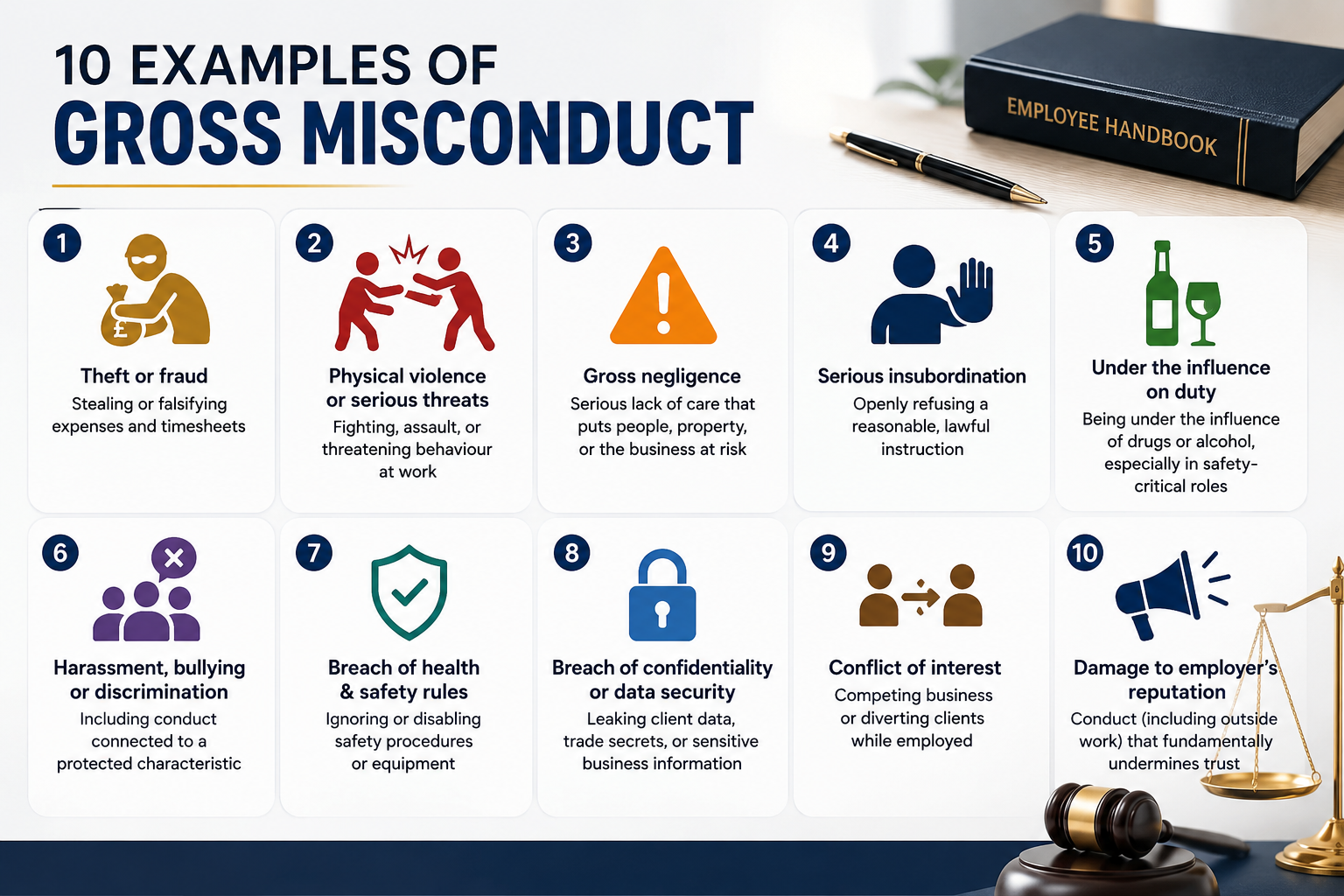
There’s no fixed statutory list. Every employer should set out its own examples in the staff handbook or contract. But these 10 come up again and again in practice:
1. Theft or fraud:
Stealing from the employer, colleagues, or clients, or falsifying expenses and timesheet.

2. Physical violence or serious threats:
Fighting, assault, or threatening behaviour at work.

3. Gross negligence:
A serious lack of care that puts people, property, or the business at real risk.

4. Serious insubordination:
Openly refusing a reasonable, lawful instruction.

5. Being under the influence of drugs or alcohol on duty:
Especially in safety-critical roles.

6. Serious harassment, bullying, or discrimination:
Including conduct connected to a protected characteristic.

7. Deliberate breach of health & safety rules:
Ignoring or disabling safety procedures or equipment.

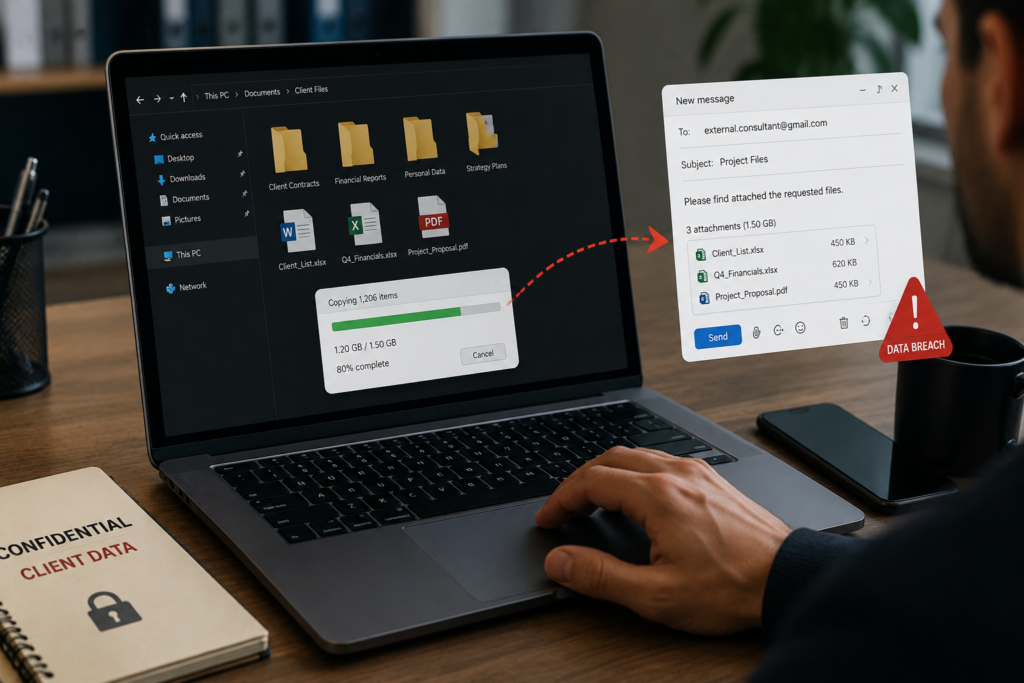
8. Serious breach of confidentiality or data security:
Leaking client data, trade secrets, or sensitive business information.
9. Conflict of interest:
Setting up a competing business or diverting clients while still employed.

10. Serious damage to the employer’s reputation:
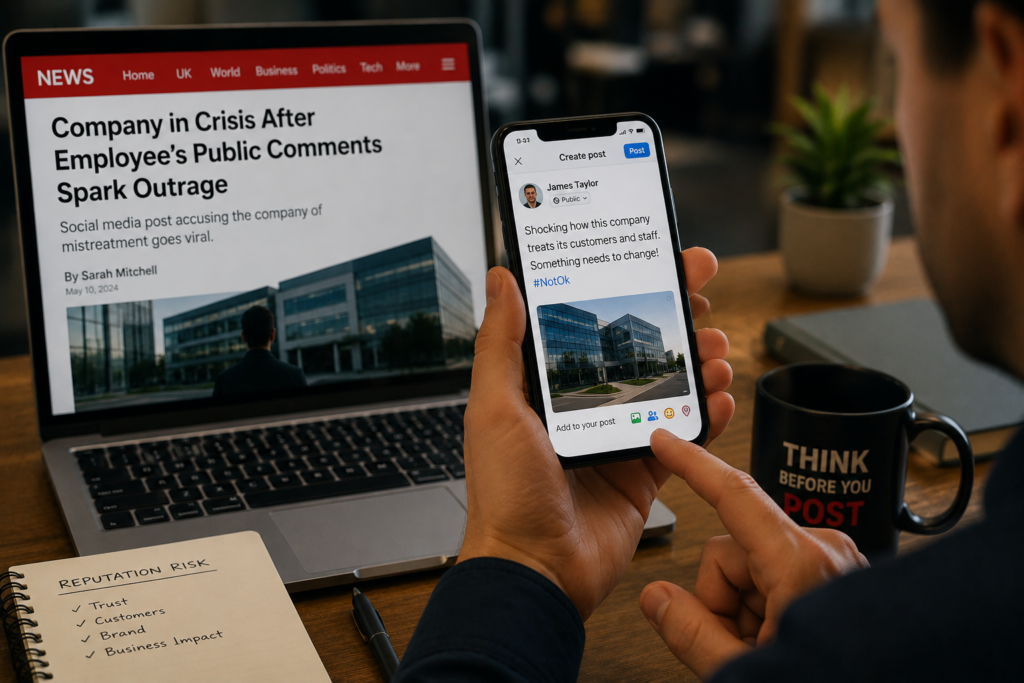
Including conduct outside work that fundamentally undermines trust.
A few of these deserve a closer look.
Insubordination only counts if the instruction was reasonable and lawful. Refusing an unlawful order or raising a genuine safety concern, isn’t gross misconduct dismissing someone for it can trigger a much bigger legal problem for the employer. Learn more about whistleblowing protections if this sounds familiar.
Dishonesty hits hardest when the employee held a position of trust. A cashier and a finance director falsifying figures are both dishonesty but the impact, and a tribunal’s view of it, won’t be identical.
Data and confidentiality breaches are an increasingly common ground for dismissal, particularly in finance, tech, and professional services. If this applies to your situation, our privacy in the workplace guidance goes into more depth.
Does Gross Misconduct Always Lead to Dismissal?
Short answer: no.
This surprises a lot of people. Even genuine gross misconduct doesn’t guarantee dismissal is lawful or the right call.
Here’s why.
The employer still has to act reasonably. Tribunals ask whether dismissal fell within the “band of reasonable responses” a reasonable employer could take a test that comes straight from case law (Iceland Frozen Foods v Jones).
Mitigating circumstances count. Long service, a clean record, genuine remorse, or personal circumstances can all tip the balance toward a final warning instead of dismissal.
A fair investigation is essential. Under what’s known as the Burchell test, the employer must show it genuinely believed misconduct occurred, had reasonable grounds to believe it, and carried out a reasonable investigation before deciding.
Skip any of that, and even a genuinely serious incident can end in an unfair dismissal claim.
What Counts as Gross Misconduct? Context Matters
The same act can mean different things in different workplaces.
Swearing at a colleague on a construction site is very different from the same words in a client-facing office. A missed safety check by a junior employee is different from the same lapse by a health and safety officer.
Employers should ask:
- How senior is the role?
- Was the act deliberate, reckless, or a genuine mistake?
- What was the actual or potential harm?
- Is there a consistent history of how similar cases were handled?
That last point trips employers up more than any other. If two employees do the same thing and only one gets sacked, that inconsistency alone can make a dismissal unfair.
How Employers Should Handle a Gross Misconduct Case
Getting this process wrong is where most tribunal claims are won not on the facts, but on the process.
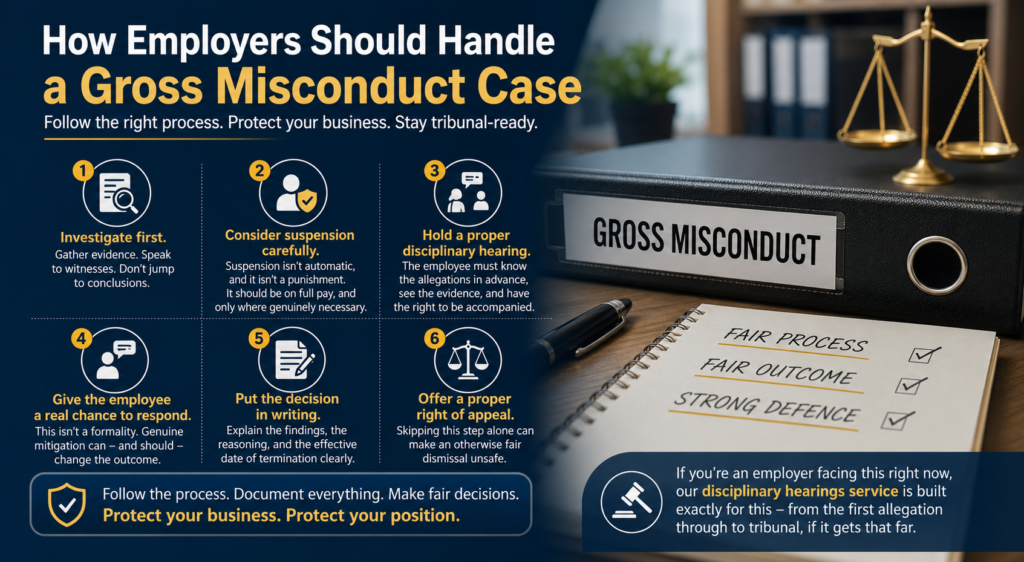
Step 1: Investigate first:
Gather evidence. Speak to witnesses. Don’t jump to conclusions.
Step 2: Consider suspension carefully:
Suspension isn’t automatic, and it isn’t a punishment. It should be on full pay, and only where genuinely necessary.
Step 3: Hold a proper disciplinary hearing:
The employee must know the allegations in advance, see the evidence, and have the right to be accompanied.
Step 4: Give the employee a real chance to respond:
This isn’t a formality. Genuine mitigation can and should change the outcome.
Step 5: Put the decision in writing:
Explain the findings, the reasoning, and the effective date of termination clearly.
Step 6: Offer a proper right of appeal:
Skipping this step alone can make an otherwise fair dismissal unsafe.
If you’re an employer facing this right now, our disciplinary hearings service is built exactly for this from the first allegation through to tribunal, if it gets that far.
How to Avoid Dismissal for Gross Misconduct (Employee Guide)
If you’ve been accused, here’s what actually matters.
Don’t panic, and don’t go quiet. Silence is often read as guilt. Respond to the process properly.
Ask for the evidence. You’re entitled to see what you’re accused of, in writing, before any hearing.
Bring someone with you. You have a statutory right to be accompanied at a disciplinary hearing.
Explain the context. Mitigating circumstances genuinely change outcomes but only if you put them forward.
Watch for mislabelling. Raising a genuine grievance, a safety concern, or a whistleblowing disclosure is sometimes wrongly dressed up as “insubordination.” If that’s happened to you, it may amount to automatic unfair dismissal a much stronger claim.
If you believe you’ve been treated unfairly whether that’s a flawed process, a disproportionate sanction, or a decision that looks like discrimination in disguise speak to a solicitor before you sign anything, including a settlement offer.
What Happens If You’ve Already Been Dismissed?
You may still have options.
Wrongful dismissal if the conduct didn’t genuinely amount to gross misconduct, you may be owed notice pay you weren’t given.
Unfair dismissal if the process was flawed, inconsistent, or the real reason was something else entirely (like redundancy dressed up as misconduct).
A negotiated exit sometimes the strongest move isn’t a tribunal claim at all, but a well-negotiated settlement agreement.
Time limits are short usually three months less one day from dismissal to bring an employment tribunal claim. Don’t wait to find out where you stand.
When Should You Speak to a Solicitor?
If you’re an employer:
Before you dismiss, not after. Getting early advice on a disciplinary case is far cheaper than defending a tribunal claim later.
If you’re an employee:
As soon as you’re accused, suspended, or dismissed not once you’ve already accepted an offer or missed a deadline.
Post-termination issues restrictive covenants, competing employment, confidentiality often surface right around gross misconduct cases too. If that applies to you, see our guidance on post-termination restrictions.
How KSC Legal Can Help
I’m Kuldeep S. Clair a senior solicitor and advocate, which means I can represent you at tribunal myself, without the added cost of separate barrister’s fees.
Over 25 years, I’ve advised both employers and employees on gross misconduct cases from the first difficult conversation through to a full tribunal hearing, if it ever gets that far.
Unlike many employment law firms in London, you won’t be passed between departments. You speak to me directly, from your first call to the final outcome.
Whether you need an employment solicitor in London to defend a dismissal decision, or you’re an employee looking for straight-talking advice from experienced employment dispute solicitors, I can help you understand exactly where you stand.
Explore our full employment law services, or get in touch directly for a free initial conversation.
Book a Consultation or call 07484 614 090.
FAQs: Examples of Gross Misconduct
What are three examples of gross misconduct?
Theft or fraud, violence or serious threats, and a serious breach of trust such as a data leak or conflict of interest.
What are 5 examples of serious misconduct?
Persistent lateness after warnings, unauthorised absence, repeated minor policy breaches, poor performance despite support, and non-threatening but inappropriate conduct.
What qualifies as gross misconduct in the workplace?
Any conduct so serious it destroys the trust between employer and employee commonly theft, violence, gross negligence, serious insubordination, or serious data/confidentiality breaches.
Does gross misconduct always lead to dismissal?
No. Even genuine gross misconduct must go through a fair investigation and hearing. Mitigating circumstances can lead to a warning instead of dismissal.
Can I be sacked without a warning for gross misconduct?
Yes, that’s the point of gross misconduct. But the employer must still investigate fairly and follow a proper disciplinary process first.
Do I get paid notice if I’m dismissed for gross misconduct?
Usually not, if the conduct genuinely meets the threshold. If it doesn’t, you may have a wrongful dismissal claim for unpaid notice.
What’s the difference between gross misconduct and serious misconduct?
Gross misconduct can justify instant dismissal. Serious misconduct is more concerning than a minor issue but usually results in a warning, not dismissal.
Speak to KSC Legal Today
You don’t need every detail figured out before you call.
If you’re unsure where you stand as an employer or an employee start with a conversation.
As one of the more accessible solicitors in London, I offer direct access, honest advice, and no call centres in between.
Contact KSC Legal or call 07484 614 090 to talk it through.